Three to five posts a week with the same character, held for 60 to 90 days. Repetition beats polish. Four consistent posts will build more recognition than one beautiful one, and it isn't close.
Cost starts at $22 a month, because one tool now covers images, voice and lip sync. Add an image tool for more range and it's $27 to $71. Near enough flat regardless of how much you post. That's the structural difference from filmed content, where every video costs again.
This article assumes you've already got a character and she stays the same between posts. If she doesn't, stop here and fix that first, because cadence built on a drifting avatar just produces more content nobody recognises. The reference pack method covers it.
What I want to talk about here is the boring operational half that nobody writes about: how often, how much, and what to watch.
The cadence that builds recognition
Three to five posts a week, same character, for 60 to 90 days before you judge anything.
The reason has nothing to do with algorithms and everything to do with how people work. Familiarity comes from repeated exposure, and it's one of the most reliably replicated findings in psychology: we come to prefer things simply because we've encountered them before. Not because they were impressive. Because they were there again.
Which means at the awareness stage, showing up four times a week competently beats showing up once beautifully. Your audience isn't scoring your production. They're slowly deciding whether they recognise you.
For a busy woman this is genuinely good news, because the constraint that normally makes this cadence impossible is filming. Hair, lighting, finding an hour where the house is quiet, doing eleven takes because you stumbled. Take that out and four posts a week becomes an evening's work.
Three months, realistically
- Weeks 1 to 4. Nothing much happens. This is the part where most people quit, and quitting here is the single most expensive thing you can do. You are building the sample size, not the audience.
- Weeks 5 to 8. Patterns appear. Two or three posts will noticeably outperform the rest. That's your data, and it's worth more than any advice I can give you.
- Weeks 9 to 12. Recognition starts showing up as behaviour: repeat commenters, people referencing older posts, DMs that assume you know each other. That's the thing you were building.
Three to six months to meaningful growth is the honest range. Anyone promising ninety days to a full-time income is selling you the exception as if it were the rule.
What the exception looks like
Since I've just told you to expect a slow first month, it's only fair to show you the other end of the distribution.
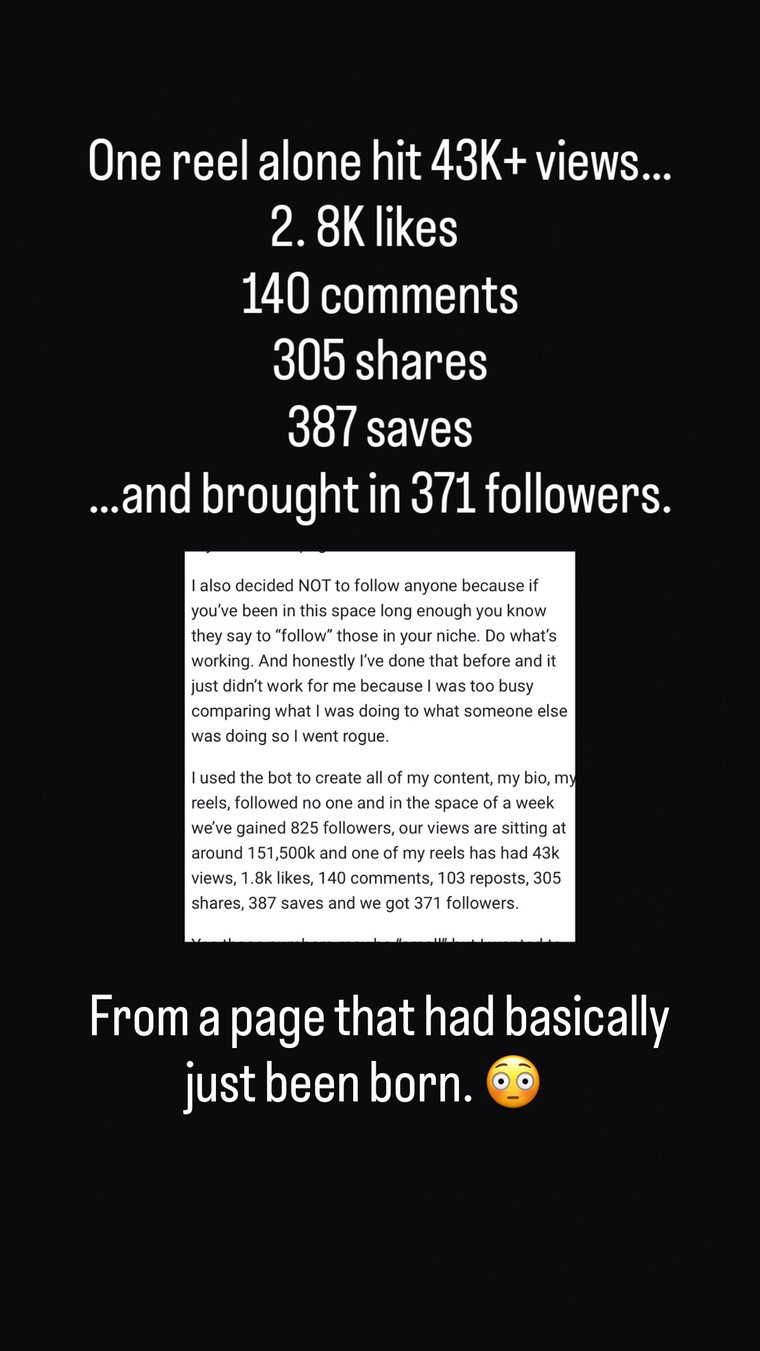
One of our members, Sienna, started a brand new account with a brand new character and no existing audience. One week later she was on 825 followers and roughly 151,000 views. A single reel did 43,000 views, and by the end of that first week it had 1,800 likes, 305 shares, 387 saves and had brought in 371 followers on its own. She passed 1,000 followers a few days after that.
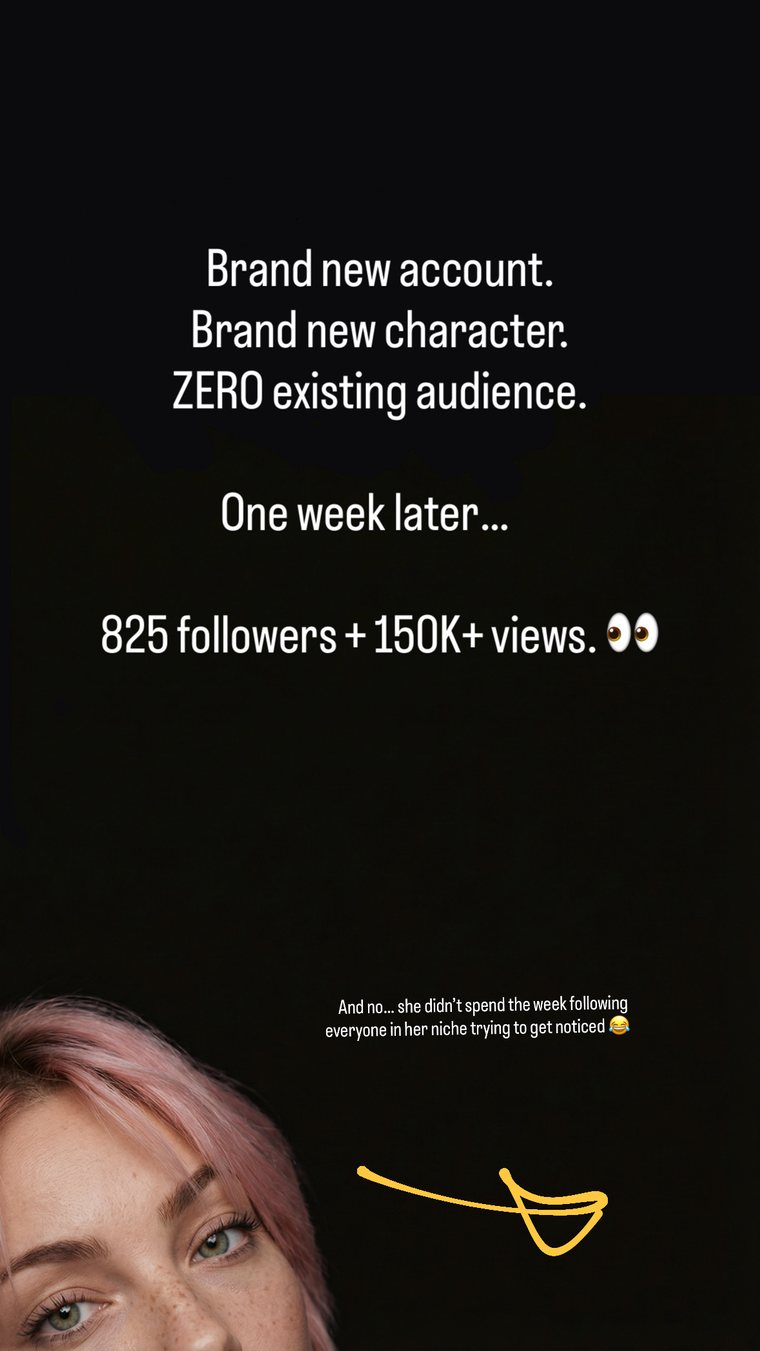
That is not typical and I'm not going to pretend it is. Everything in the section above still stands, and I'd rather you planned for a quiet first month than for this one. Most people will not have Sienna's week.
But it's worth looking at what she actually did, because very little of it was luck:
- She locked the character before posting anything. She used Build Him, the free quiz on this site, to build him properly rather than generating as she went.
- She spent the week on positioning, not on more images. Bio, content direction, who the page was talking to, why anyone would come back. That's the part almost everyone skips in favour of making another pretty picture.
- She followed zero people. Deliberately. The standard advice is to follow everyone in your niche, and she'd tried that before and found she just ended up comparing herself to them. So she stopped looking and built something that didn't resemble anyone else's page.
- She picked a genuine gap. A male, podcast-style avatar. Male AI creators exist, but very few were doing that specific format.
Look at the shape of that reel's numbers, too, because it maps exactly onto the metrics section below. 387 saves and 305 shares against 1,800 likes. The saves and shares are what carried it, which is the whole argument for watching those instead of likes.
The two I'd steal are following nobody and picking the gap. Most accounts in this space are a slightly worse version of the account their owner admires most, and it always shows.
Worth being straight about one thing: the positioning work she did runs on a bot inside Human AI Premium, which is the paid tier. The character came from the free quiz, the brand-building did not. I'd rather say that plainly than have you join the free side expecting Sienna's week.
What it costs
My actual monthly stack, at the time of writing:
| Tool | What for | Roughly |
|---|---|---|
| ElevenLabs Creator | Images, voice and lip sync. The whole job, one tool | $22/mo |
| Higgsfield (optional) | More range on images and clips | $5 to $49/mo |
| Google Flow (optional) | Veo video, Nano Banana images | Free allowance, then from $19.99/mo |
| Instagram Edits or TikTok editor | Captions and trimming | Free |
| Canva | Carousels and stills | Free tier works |
The floor is $22, because everything can be done inside one tool if you want it that way. Images, voice, lip sync, all in ElevenLabs. Most people eventually add an image tool for more range, which is where the $27 to $71 comes from depending on which one and which tier.
Check current pricing before you commit. It moves faster than anything else in this article.
One honest caveat on the upper figure. Video generation burns credits by the second, so a heavy posting month can push you onto a bigger tier than I've costed here. If you're posting five times a week rather than three, budget above the top of that range rather than at it.
Compare that to filmed brand video, which starts in the low thousands per finished video and recurs every single time you want another one.
But the number isn't the interesting part. The shape of the cost is. Filmed content is priced per video, so posting more costs proportionally more, which is why brands ration it. Avatar content is a flat subscription, so going from four posts a month to twenty costs you nothing extra beyond credits. Volume stops being a budget decision and becomes a time decision, and that inversion is the whole reason this model works for people with jobs.
The five numbers worth watching
Check these every 30 days. Not daily, because daily checking teaches you nothing except anxiety.
- Completion rate. Are people watching to the end? The single best signal of whether your hook and your length match.
- Saves and shares. Worth more than likes, both as ranking signals and as honest evidence that something was useful enough to keep.
- Profile visits from content. The bridge metric. Reach without profile visits means the content performed but the person didn't land.
- Follower growth rate. Rate, not count. Count flatters you, rate tells you whether the last month worked.
- Conversion to your one next step. Quiz completions, community joins, list signups. Whatever your single destination is.
Likes are not on that list deliberately. They're the number that feels most like feedback and predicts the least.
Before you commit to a cadence, lock the character
Four posts a week only compounds if it's the same woman in all four. The Avatar Quiz takes twelve questions and hands you a complete prompt pack, reference images plus your first podcast and yap stills, so the character is fixed before the volume starts. Free.
Where to spend the volume
Not everything is worth the same effort. Ranked by what I'd actually prioritise:
Short talking-head reels. Under 15 seconds where you can manage it, looping naturally. This is the format the platform currently rewards most and the one avatars handle best.
Stories, daily. Nobody wins on stories in month one, which is exactly why most people skip them. It's where followers turn into buyers, and it's the cheapest content you'll make.
Carousels with a genuine angle. Saves are a strong signal and carousels get saved. Good for anything with steps.
Explainer and FAQ content. Underrated for authority. These formats are information-dense, which is where an avatar's clarity matters more than emotional nuance, so it plays to the format's strengths rather than against them.
What I'd deprioritise early: long-form video, multi-platform posting, and anything requiring a second character. All fine later, all a distraction in month one.
Label it. This one isn't optional
If you post a photorealistic AI person, you have to label it. That's not me being cautious, it's platform policy, and the enforcement got sharp this year.
TikTok has an AI-generated content toggle in the posting flow. Switch it on and an "AI-generated" badge appears under your username. It's required for photorealistic AI humans, AI voices that impersonate a real person, and fully AI-generated scenes presented as if a camera captured them. Which is a precise description of what most of us are making.
Two things about TikTok's version matter. They detect synthetic media automatically through C2PA content credentials, so not disclosing doesn't mean not being caught. And strikes are now immediate rather than warning-first: first offence is removal plus a strike, second is a seven day posting restriction, third is thirty days. They removed tens of thousands of unlabelled AI videos in one sweep.
A thirty day posting ban would undo an entire quarter of the cadence this article is about.
Instagram works differently. There's an account-level AI creator label you enable once in your profile settings, which then applies across your account and future posts, plus per-post disclosure for individual pieces. Meta also applies its own labels when it detects AI content.
So the practical version is about two taps. Turn the account-level label on once, use the per-post toggle when you publish. That's the whole compliance job.
Worth saying that AI-assisted text, scripts, captions, hashtags, isn't what these rules are about. It's the photorealistic depiction of a person that triggers them.
And the trust argument runs the same direction as the rules, which is convenient. In this niche your audience usually works it out anyway. Labelling costs you nothing, and getting caught not labelling costs you both the strike and the credibility you spent three months building.
The short version
- Three to five posts a week, same character, 60 to 90 days before judging.
- Repetition beats polish. Familiarity is built by turning up, not by impressing.
- Weeks 1 to 4 look like nothing. That's the part where people quit.
- The exception exists. One member hit 825 followers and 151k views in week one, by locking her character, working the positioning, following nobody and picking a gap.
- $22 a month for one tool that does everything, $27 to $71 once you add an image tool. Cost stops scaling with volume the way filmed content does.
- Watch completion, saves, profile visits, growth rate, conversion. Not likes.
- Short reels first, stories daily, carousels for saves. Skip everything else in month one.
- Label your AI content. TikTok's toggle, Instagram's account label. Strikes are immediate and detection is automatic.
None of this is clever. It's just the operational half that gets left out of articles about avatars, and it's the half that decides whether you're still doing this at Christmas.